We use cookies to provide you with the best possible experience. They also allow us to analyze user behavior in order to constantly improve the website for you.
The consent is voluntary. You can withdraw it at any time or renew it in Cookie settings on the home page. Withdrawal of your consent does not affect the lawfulness of processing performed before the withdrawal.
Privacy Protection Policy
Most scenes render 20-50% faster, and this release introduces final frame rendering on the GPU with the updated V-Ray RT.
Like V-Ray for 3ds Max, 3.3 for Maya has the new Variance-based Adaptive Sampling. This means faster set-up and less adjustments since lights and materials are evaluated automatically. And these are just a few of the many new features.
“V-Ray for 3ds Max and Maya are now at the same level,” said Chaos Group CTO Vlado Koylazov.
The update also implements Chaos Group’s Variance-based Adaptive Sampler, intended to make noise removal in images less dependent on material or lighting settings, and to improve sampling of alpha channels.
In addition, GPU support has been added for rendering hair - there is a support for Alembic hair within V-Ray RT GPU – subsurface scattering, displacements, tiled textures, and light cache GI.
New features in V-Ray 3.3 for Maya
Ray Traced Rounded Corners
Generate smooth edges between different objects at render time with no extra modeling
Blended Triplanar Mapping Texture
Quickly apply seamless textures without UVs
Stochastic Flakes Material
Create ultra-realistic materials with sparkle effects like snow, sand, and car paints
V-Ray Falloff Texture
Add falloff and Fresnel effects based on viewing direction
New Sky Model and Aerial Perspective
Simulate more natural looking skies with the new Hosek sky model, and add realistic atmospheric depth with the aerial perspective volume shader
V-Ray Clipper with Render-Time Booleans
Create sections and cutaways using any mesh objects
Updated features
Faster Volume Rendering
Faster volume rendering with probabilistic sampling
Supports OpenVDB caches from Houdini 15 and FumeFX
Preview volume grid objects in the Maya viewport
Improved Global Illumination
More robust reflective GI caustics for better light propagation, and more natural illumination of interior scenes
Look Development
Now supports look development nodes introduced in Maya 2016 Extension 1
OpenSubdiv 3.0
Now supports the latest version of OpenSubdiv
Up to 2X faster performance when calculating the subdivided meshes
Added support for color sets
XGen
Cache XGen collections to V-Ray scene files for better performance
Added support for displacement, subdivision, and custom attributes through VRayUserColor texture
Added support for frame animation from archive
User Interface
Optimized user interface and default render settings
Pricing and availability
V-Ray 3.1 for Maya is available for Maya 2013+, running on 64-bit Windows, Mac OS X and Linux. A workstation licence costs $1,040; render nodes, which also work with other versions of V-Ray, now start at $350.
Evermotion presents, Vray Workshop Principal artist group online on Facebook. Evermotion is pleased to announce a partnership with Vray Workshop group.
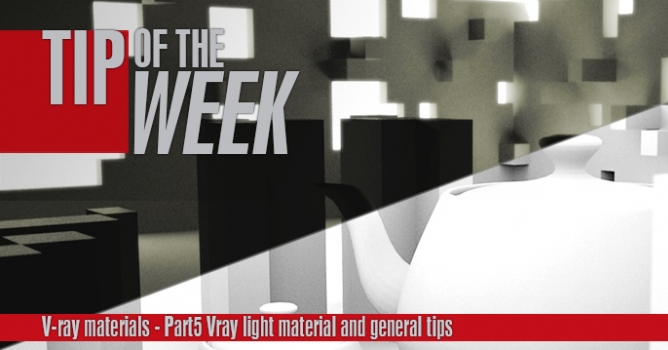
This is the last part of a V-ray materials tip of the week series. In this part I will show you how to use V-ray light materials and some general tips for baking v-ray dirt and using opacity maps.
Evermotion presents, Vray Workshop Principal artist group online on Facebook. Evermotion is pleased to announce a partnership with Vray Workshop group.
In this walkthrough, we guide you through the process of building a polished 3D interior scene inspired by the cover of Archmodels vol. 306 – Table Sets.







 Customer zone
 Your orders
 Edit account
 Add project
 Liked projects
 View your artist profile
COMMENTS