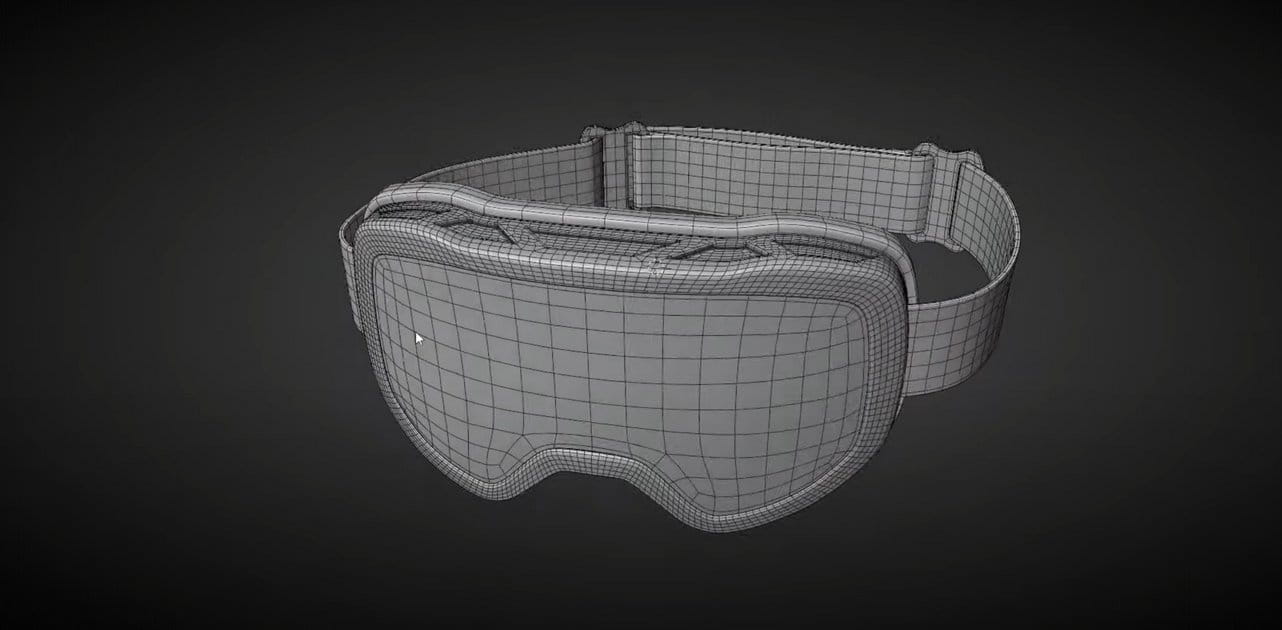
Topology Study : How To Model Ski Googles in Blender
Using Blender modeling tools for creating realistic ski googles.

In accordance with the art. 13 section 1 and 2 of the European Parliament and Council Regulation 2016/679 of the 27th April, 2016 on the protection of natural persons, with regard to the processing of personal data and on the free movement of such data, and repealing Directive 95/46/EC (General Data Protection Regulation), hereafter RODO, I hereby inform that:
1. EVERMOTION S.C., 8 Przędzalniana Str., 15-688 Białystok, Poland is the Administrator of your Personal Data (APD)
2. Data Protection Inspector can be reached through e-mail: iod@evermotion.org
3. Your personal data are to be processed on the basis of art. 6 section 1 letter a, b and f of RODO in order to:
a) prepare, conclude and execute the agreement and for other purposes approved by you,
b) to execute the legitimate interest like marketing of products and the agreement, claim assertion or defence against claims resulting from the law regulations.
4. Entities entitled to the reception of your personal data may be the authorised public bodies; mail providers; providers of the services covered by the agreement; responsible for debt recovery, keeping the archives, document utilization, legal consulting, technical services, IT services and accountancy.
5. Your personal data shall not be transferred to the third country, nor to the international bodies.
6. Your personal data shall be processed within the period of the agreement and upon your additional consent until you withdraw it. APD shall keep the data for the period of any civil law claim execution connected with the agreement.
7. You have the right to demand an access to your personal data, to correct or to delete the data if there is no other basis for the processing or any other purpose of such processing or to limit the processing of the data, to transfer the data to another administrator and to raise objections to the further data processing if there is no legal basis for further processing and to withdraw any previous consent.
8. You provide the personal data voluntarily, however they are necessary to conclude the agreement. The refusal of providing such data may result in the refusal of the agreement conclusion.
9. You have the right to lodge a complaint to the Personal Data Protection Office when in your opinion the data processing violates the regulations of General Data Protection Regulation of the 27 April, 2016 (RODO).
10. Your data will be automatically processed, including the form of profiling.
11. You are obligated to forward above mentioned information to your representative, especially if you appointed this person in the agreement as the contact person or as the representative for the agreement execution.
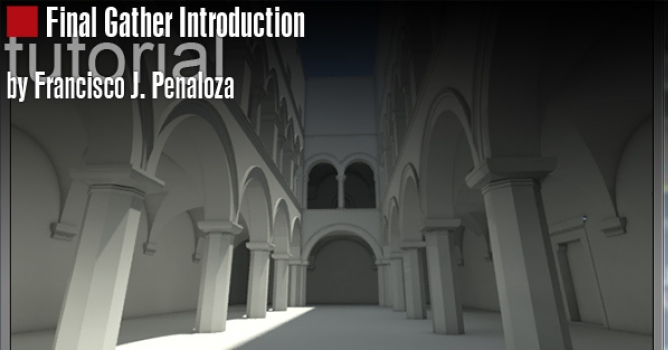

I'm actually using the version 2009 of 3D max but the same concepts can be applied to the newest version 2010. This tutorial is not trying to explain in depth all the features of Global Illumination with Mental Ray, I would like to explain the most important concepts that will help you to develop your own rendering technique and apply this knowledge to different scenes in a optimal way, with out over-killing values that will only increase your render time.
To start we open the rendering menu, select the indirect illumination option, basically Mental Ray has 2 way to simulate indirect illumination, one is called Final Gather the other one is Global Illumination. I will cover Final Gather only in this tutorial.
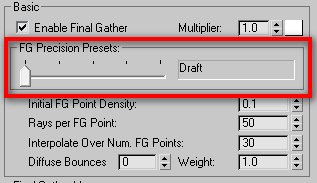
In the Final Gather window the first scroll control, configure FG with different preset values, as you can see, this preset can be easily used in a production environment, but from time to time you'll need some extra tweaking of these values, to get the optimum result between render time and quality.
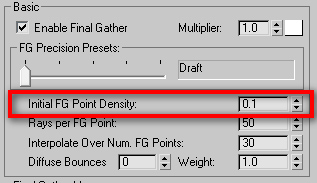
This area is the core of FG and this values are the fist that we should play with.
Initial FG point density: control how "dense" or how many FG rays are in one sample area, that means when the bigger these values are, the more FG ray will be concentrate in one area, then your solution will be more precise, but the FG calculation will take longer.
Rays per FG point: This controls how many ray of FG are counted for your solution, more rays, more precision, but at cost of render time, this is one of the controls that I play the most.
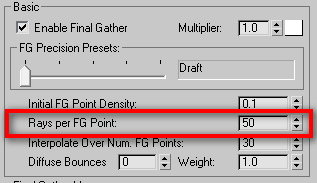
Interpolate over number of FG point: This option controls how many ray are merged or how many rays are counted to get one average lighting information, this can speed up your render time and mostly smooth some dark areas of you FG solution, but if you over use it the Indirect illumination solution will be less precise and also can create some over bright areas.
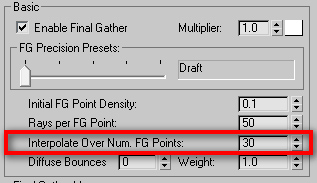
Diffuse bounces: This control how many bounces in the scene a FG ray will have before it return the light information, when more bounces, the scene will tend to be more illuminated, but the render time will be longer.
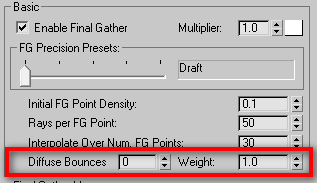
So let's get started with a practical exercise. I will work with the Sponza Atrium scene, from Marko Dabrovic(mdabrov@rna.hr) well known to many of you.







LEAVE A COMMENT





|

|

|

|

|






COMMENTS